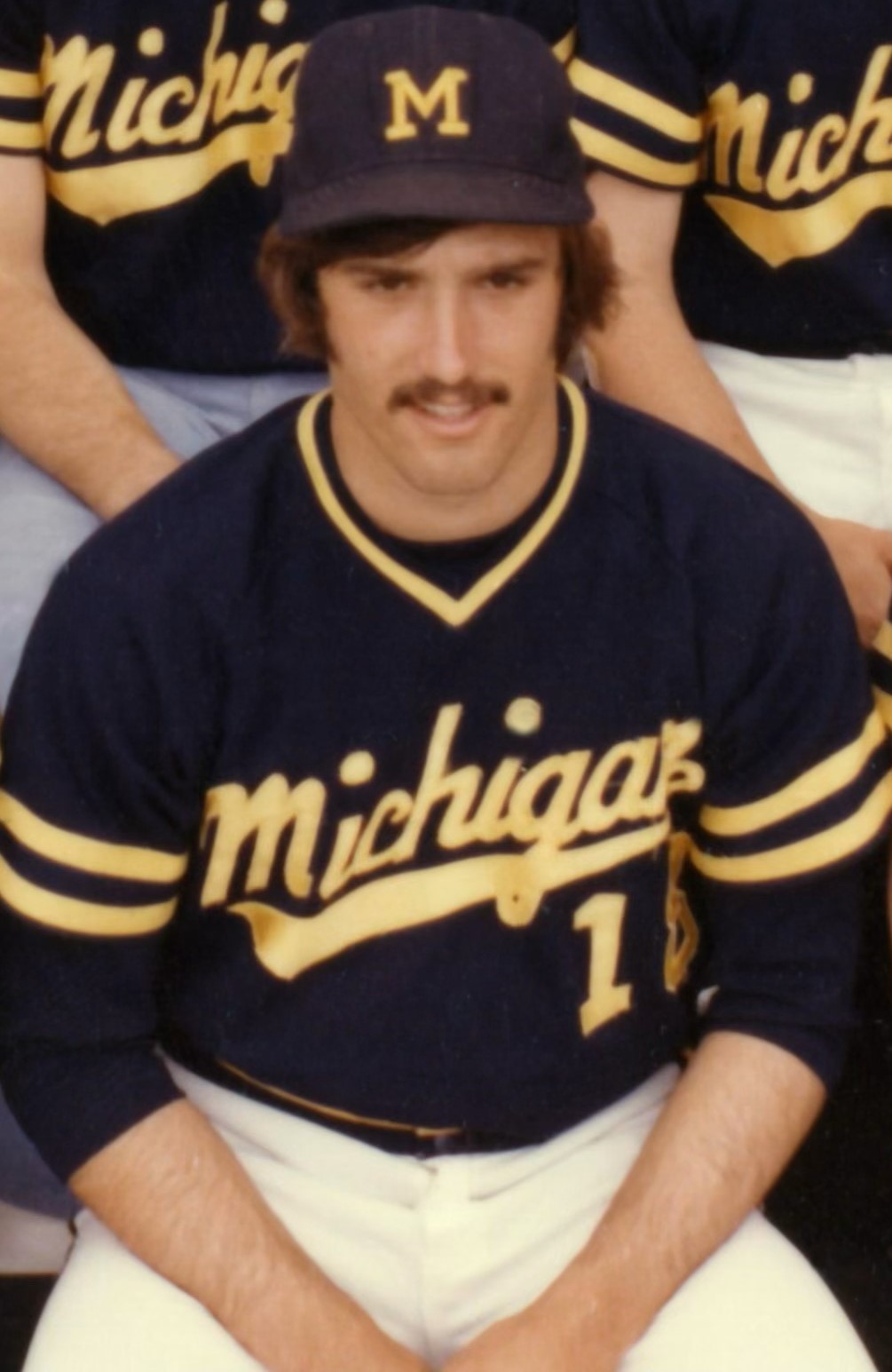
On the day of his greatest performance, Mark Weber didn’t feel like he was in any condition to pitch.
When he wasn’t pitching for Swartz Creek High School and wasn’t studying in preparation to eventually become a doctor, Weber mowed lawns occasionally for one particular gentleman.
Emphasis on occasionally.
“One guy I mowed grass for would only call me when the grass was a foot tall, and it took me forever,” Weber said.
Wouldn’t you know it, Weber’s lawn services were requested the day he was scheduled to pitch in the opening round of the 1972 Greater Flint Invitational Baseball Tournament at Lincoln Park.
“It took me four hours in the sun to mow grass,” Weber said. “By the time I got to the game, I was exhausted. For whatever reason, it loosened me up to where I threw very hard and my ball had great motion on it.”
Seven innings later, Weber had struck out 21 Montrose batters in a 4-1 victory.
The Rams were no pushovers. Flint Journal sports writer Dean Howe wrote: “Weber’s performance has to rank with the finest in Flint-area history, especially against what is considered a sound-hitting Montrose unit.”
At one point, Weber struck out 11 straight batters. He fanned four in the sixth inning when the third strike was dropped by the catcher.
“He totally missed the ball, because the ball moved so well,” Weber said. “To me, it was a thrill of a game. I can remember one of our best players sitting on the bus. He turns to me and said, ‘I’ll never forget this day, Mark. To sit next to somebody who struck out 21 batters is phenomenal.’”
Weber was also congratulated two days later by his counterpart in that game, Montrose lefty Bill Davis, who showed up to watch Weber no-hit
Owosso in the next game.
Fifty-two years later, Weber and Davis remain in touch.
“We became good friends,” Weber said in October 2024. “We talked a month ago.”
Weber made all-state that season and finished his Swartz Creek career with a 29-9 record.
He went on to pitch for the University of Michigan, where his name remains in the school record book.
His earned-run average of 1.47 in 1975 remains third in school history, as does his career ERA of 2.05. His walks and hits per innings pitched of 0.97 in 1975 ranks sixth.
Weber was co-Most Valuable Player for the Wolverines in 1975 and 1976, making the All-Big Ten Conference first team in 1976.
He played alongside future major leaguers like Lary Sorensen and Rick Leach, but never got his shot at the big time.
The reason? He stood only 5 feet, 9 inches, a turnoff to pro scouts.
“I never got drafted,” Weber said. “That was probably the saddest day in my life. I went to Europe and played two years during medical school. I never had anybody approach me.
“Interestingly enough, I played in the Cape Cod league, where everybody is drafted. Every game they had 15, 20 scouts, and I threw really well. I was the starting pitcher from the first day. They had guys from all over the country twice my size. I was our No. 1 pitcher. Not a single scout ever talked to me.”
Fortunately for Weber, his backup plan worked out marvelously.
Becoming a doctor was always his long-range goal, one he hoped to delay for a pro baseball career. He was a zoology and biology major while playing college baseball and eventually was accepted into Michigan’s medical school.
Balancing the demands of being an NCAA Division I athlete with a
rigorous major didn’t allow for much extra time.
“There weren’t a lot of guys on my team who were real studious, but a few of them were,” Weber said. “We all kind of did the same thing. You had to have a very, very structured life. You took all your classes in the morning at either 7 or 8. Because I was a zoology and biology major, I had to do a lot of labs. It was tricky because usually we started practice at 2 or 3, so you had to get your lab work done before, then have a three-hour practice, then right to dinner and right to studying at 7 and go until 11. You almost have like an Army life.”
Weber became an orthopedic surgeon, working in West Branch for nearly 40 years. He still lives in West Branch and also owns a home in Mexico.
Weber gravitated toward becoming a pitcher and a surgeon for similar reasons.
“Being a surgeon, you’re totally in control of what you’re doing,” he said. “The outcome is very directly related to how good you are. As a pitcher, you’re in control. The end of the game is so dependent on how well you do. Obviously, it depends on other things, too. In surgery, you’re dependent on the people you’re working with; it’s no one-man show. At the same time, it’s nice to be in control. I liked that part of pitching.”
