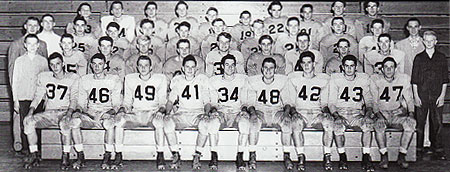

Front Row: Dale Hicks, Bob Foster, Don Howe, Bob Cruse, Bob Barnett, Jerry Myers, John MacGillivray, Jim Moore, Anthony Miller. Second Row: Edward Hirschenberger, Ben Raver, Glen Sandvik, Ray Flavin, Darrell Chick, Delane Smith, Jim Krause, Willard Hawkins, Warren Wllliams, Al Allard, Dixon Jackson. Third Row: Mr. Carlson, Frank Sturgeon, Mike Perez, John Newby, Keith Foster, Wayne Robinson, Sillman Jordan, Jim Crockett, Bill Odykirk, Clinton Miller, Dick Oberlin, Mr. Sweet. Back Row: Melton Drummond, Doren Barney, Dale McBride, Dick Doty, Donald Sting, Art Maxwell, Ron Wellman, John Smith, Paul Greenman, Homer Anderson

Dye High School football in 1952 and 1953 was a testament to what one man could do as a coach.
The Thunderbolts were nothing in 1950, nearly league champions in 1951 and undefeated the next two years, including a state championship in ’53. Their matching 8-0 seasons in ’52 and ’53 have earned those teams induction into the Greater Flint Area Sports Hall of Fame as a single entry this fall.
The difference was the arrival of Len Sweet as coach in 1951, the lightning rod that put a charge in Dye players and sent them thundering across the gridirons of the County C League on an 18-game winning streak.
The ‘Bolts outscored their opponents 236-12 in 1952 and 290-32 in ’53, recording 10 shutouts and allowing just three teams within three touchdowns of them. Sweet, one of the Northern High “Wonder Boys” of 1939-41, coached only the ’51 and ’52 teams before his life was cut short in a traffic accident. But his influence and half his players carried over to the ’53 squad under the capable hands of Bill Yancey, who took them the final step to a state championship.
“Len Sweet, not unlike all great coaches, had that rare gift of inspiring his players to be better athletes than they ever realized they could be,” said Dale Hicks, a senior center and linebacker on the ’52 squad. “He just had that aura and intensity and respect you couldn’t help but give him.”
That was the first step, according to Bill Odykirk. The four year varsity halfback clearly recalls the day the attitude changed at Dye. “We had a spring meeting in 1951 and he said, “You guys slouching around the halls, you’d better get your shoulders back, your head up and walk like you’ve got some pride,” Odykirk said. “All of a sudden, we found out about football. We were so terrified of this guy,” said Hicks. “He was all business and we weren’t used to that. You’d make a mistake and he’d kick your butt.
“We almost won the championship that first year.” Dye went from 1-7 in 1950 to 5-1-2 in ’51, losing only to a Mandeville team that was inducted into the Flint hall in 2007.
There would be no more losing for almost 2 1/2 seasons.
With most of his players back and their mindset right, Sweet and assistant coaches Ray Carlson and Fritz Lamb turned Dye into the new Class C power in Genesee County and the third ranked team in the state.
Odykirk became a bruising, 185-pound halfback who scored 76 points and was second-team All-State. “Jarring” Jimmy Moore, the fullback, added 66 points, scatback Bob Barnett 48 and quarterback Bill Hawkins 36.
The defense — led by all-leaguers Don Howell and Anthony Miller on the line, Jerry Myers at linebacker and Moore at defensive back — allowed just two scores all year. “A couple of long passes got over our heads in the secondary,” said Hicks. “Nobody scored against us on the ground. That was a tribute to (line coach) Lamb. He had great coaching ability, too.” The Week 3 showdown with Mandeville turned into a 20-0 rout, and Dye was challenged only by Utley, 14-6 in Week 6. Hoover canceled out of the final game.
Yancey faced a rebuilding job on the line in 1953, and Mandeville was tabbed the preseason favorite. But with everyone but Odykirk back in the backfield, Dye was even more explosive. Moore led the offense with 920 yards and 80 points and was voted All-State. Dick Oberlin took over for Odykirk at halfback, and ends Jim Krause and Al Allard benefited from 12 touchdown passes by Hawkins. The Thunderbolts seldom took more than eight plays to score and had at least 10 TDs of 35 yards or more.
They edged Mandeville 14-7 in Week 3 and Otisville 13-6 two weeks later. By the time they clinched the league title with a 37-6 rout of Utley in Week 7, they were No. 1 in two state polls and a game was being sought with unbeaten Detroit St. Charles.
That match was never made, but the little school at the corner of Dye and Corunna roads reigned as state champion in the United Press and Detroit Times Class C-D polls. “They were incredible athletes and incredible kids,” said Carlson. “They were all that way. You expect to have maybe a few, but they were all just super young men, not only on the field but in the hallways and the classroom.”
Moore and Hawkins went on to Michigan State but didn’t stay long. Krause played at East Tennessee State and became a banker.
Odykirk played at Central Michigan, coached at Northern Arizona for a while and returned to CMU as an assistant, eventually serving on the board of trustees among other ventures. He credits Sweet for changing his life. “I would have been in the Stroh’s club at the West Side bar, pushing cars at Buick for 30 years,” Odykirk said. “He showed me the way out.”
Hicks went on to Michigan, although not to play football. He went on to build 450 homes in Genesee County over the next 15 years. He laments the number of kids who never got the chance to play for Len Sweet.
“Sometimes you wonder why they take the good ones ” Hicks said. “He could have been such an inspiration to so many players in his lifetime.”
READ FULL BIO