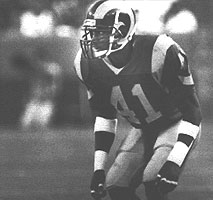
 Todd Lyght went to Notre Dame to become the next Tim Brown.
Plans quickly changed, as they often do once a recruit steps foot on campus.
Lyght didn’t become the next Tim Brown. Instead, he became the first Todd Lyght.
That, as it turns out, wasn’t such a bad thing.
Recruited as a wide receiver out of Flint Powers Catholic, Lyght was moved to cornerback shortly after enrolling at Notre Dame in the fall of 1987, the year that Brown won the Heisman Trophy.
The move enabled Lyght to get more playing time than any other Irish freshman that year. He went on to make All-America as a junior and senior, won the 1988 national championship and intercepted 11 passes during his career.
He lived up to his status as the fifth overall pick in the 1991 NFL draft, playing a key role in the 1999 St. Louis Rams’ Super Bowl championship season and making Pro Bowl appearances in 1999 and 2000.
Lyght might have achieved all those things as a wide receiver, his preferred position coming out of high school, but there’s no guarantee. In retrospect, Lyght can now thank Notre Dame coach Lou Holtz for making the switch.
“The expectation when I went in there was I was going to play offense,” Lyght said. “I played wide receiver maybe three weeks tops. Then I knew something was going on, because wide receiver coach Pete Cordell was the meanest guy to me ever and made it so uncomfortable for me. Defensive backs coach Terry Forbes was the nicest guy in the world to me. I figured something was going on. It worked out really well for me. At the time, I thought I’d be a better offensive player. Now, looking back on my career, coach Holtz knew what he was doing.”
Playing defense meant that Lyght went up against Brown every day in practice. It was during those practice sessions that Lyght began to realize he had a shot at playing in the NFL.
“I always thought about getting to the next level,” Lyght said. “I didn’t realize I was going to be able to play at the pro level until my freshman year in college when I was going up against Tim Brown in one-on-one drills. Obviously, at the time he was one of the better players in the country and I was sticking with him pretty well. I was a freshman and was able to hang with one of the best players in the country. That’s when the light went on that I could play at the next level.”
Lyght was on the field for one of the most memorable plays in Super Bowl history.
The Rams had just taken a 23-16 lead against the Tennessee Titans on a 73-yard touchdown pass from Kurt Warner to Isaac Bruce with 1:54 left in Super Bowl XXXIV at the Georgia Dome.
The Titans, who had tied the game with 2:21 to go, quickly marched down the field all the way to the Rams’ 10-yard line with six seconds left. On the final play, Tennessee’s Kevin Dyson caught a pass from Steve McNair short of the end zone. He was tackled at the 1-yard line by St. Louis’ Mike Jones, stretching in vain for the goal line as time expired.
Lyght was on the far side of the field when history unfolded.
“They had to go about 70 yards and needed to score and kick the extra point to tie it,” Lyght said. “They were three or four plays into it and on the 50-yard line. I remember being so tired.
“I’d never been that tired in a football game before in my entire life. I remember sitting there at the 50-yard line with my hands on my knees, sweat on my face and thinking, ‘This is it, this is the moment when we need to suck it up.’ You’d have no energy, then when the quarterback hiked it you’d find energy for that one play, then the ref blew the whistle and you’d be tired again.”
Lyght was born in the Marshall Islands and lived in Virginia and Georgia before coming to Flint midway through his freshman year when his father, William, became Flint’s police chief. As a new kid in school, he played junior varsity football in 10th grade at Powers before starring on the varsity in 1985 and 1986. He made All-State and All-American as a receiver in 1986, catching 34 passes for 887 yards and 11 touchdowns. He also picked off 10 passes.
READ FULL BIO