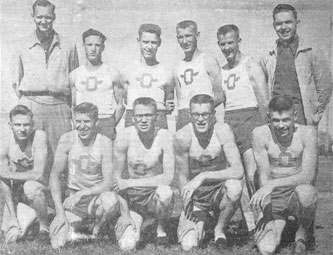

The scorers and coaches for Otisville High’s 1951 track team (front row from left): Duane Linderman, Rollie Hughes, Bob Price, Ned McCormick and Bob Willingham. Standing (from left) : Coach Leroy Gunderson, Nort Averill, Clare Wheeler, Dave Manser, Boyd Haddix, and Coach Fred Jackson.
They came out of nowhere to win a state championship,then faded from existence almost as quickly. The Otisville Spartans were a track program only three years old when they ran to the Class D title in 1951, and they were gone four years later, folded into consolidation with two other school districts to become the LakeVille Falcons.
No one, however, can erase the mark the Green and White Spartans made in the state record book that rainy Saturday in Ann Arbor. Nine members of the 18-man team qualified for the state meet at the University of Michigan and every one of them scored at least one point as Otisville totaled
45 points to beat defending champion Benton Harbor St. John by six.
Senior captain Bob Willingham was the workhorse, piling up a meet-high 17 points with second-place finishes in the high jump, pole vault and 120-yard high hurdles and a fourth in the broad jump. But it was the medley relay quartet of Bob Price, Boyd Haddix, Nort Averill and Rollie Hughes that splashed to victory in the dramatic final event to secure the crown. As Paul Laing relates in his History of Otisville, Price opened a big lead from the start and his crewmates stretched it into a 10-yard victory over Benton Harbor St.John.
“There was a guy from MSD (Don Boone) I had run against for two years and I finally beat him leading off that relay,” said Price. “We were never behind.” Averill had the only other victory that day, coming from third place in the last 10 yards to win the 180 low hurdles in a water-logged 22.4 seconds. He had broken his own regional record a week earlier with a 21.9. Ned McCormick was second in the same race and also shared second with Willingham in the pole vault. Price tied for fourth in the high jump, Duane Linderman and Clare Wheeler each took a fourth in two separate 440’s, Dave Manser was sixth in the mile and the 880 relay squad placed fourth.
None of the Spartans knew they were championship material at the start of that spring. The third-year program had 18 athletes, many of whom also played baseball. Their meager facilities included no home track, four wooden hurdles made in shop class and a pole vault facility with wheel rims to hold the bar and a sawdust pit for landing. “We ran our sprints and hurdles on Athletic Street, near the football field,” said McCormick.
But the coaching was sound, with recent Michigan State graduate Leroy Gunderson, a former vaulter and high jumper, handling the field events and Homer Jackson the running events. The Spartans got some idea of their worth when they finished second at a state indoor meet in Albion, losing the Class C-D title by a disqualification in a relay, Averill recalls. They showed more promise at the CMU Relays, where Willingham set a record with an 11-foot pole vault and the shuttle hurdle relay also broke the meet standard. But it was in the County C meet at Dort Field where the Spartans exploded, smashing seven meet records, including most total points with 83.
Five days later they won the regional by a 58-47 margin over MSD, an established power in Class D track. Willingham, McCormick and Linderman went 1-2-3 in the pole vault, with Willingham’s 10-5 setting a regional mark. They ruled the vault with a 10-foot cane pole, the only one they had, and afterwards, coach Jackson borrowed Davison’s 11-foot aluminum pole for the trip to state. The upgrade proved helpful, with both McCormick and Willingham soaring 11 feet at state.
When rain started falling after noon, the field events moved into Yost Fieldhouse, but the running races continued on the muddy track. By the last event, “there was a puddle 30 yards long at the finish line,” said Price, and his memory is confirmed by a Journal photo of Hughes splashing through it on the final, triumphant leg. On arriving home, the Spartans proclaimed their championship with honking horns through the small town. “We had one restaurant, and everybody hung out there afterwards,” said McCormick. No doubt discussing how such a young program came to rule Class D track and field for a day. “Everybody,” Averill offered, “just had a good day that day.”
READ FULL BIO