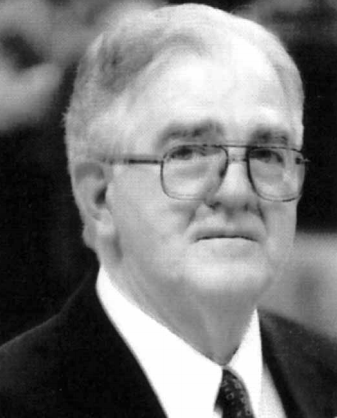
Marco Marcet has had a lot of firsts during his life in athletics. Among other things, the 1943 Flint Technical High graduate was:
-The first area High School player to shoot a basketball one-handed.
-The first athletic director, basketball coach, and baseball coach at Frankenmuth High.
-The first Flint-area native to win the Charles E. Forsythe Award, the highest honor given by the Michigan High School Athletic Association.
Marcet accepts another award tonight with his induction into the Greater Flint Area Sports Hall of Fame. This isn’t a first for Marcet. He’s already in the hall as part of the 1946 Weller’s Service softball team. Marcet might not have gained individual hall membership on his athletic achievements alone, but his work for more than 50 years at Frankenmuth has been first-rate. He compiled coaching records of 100-49 in 16 years with the baseball team and 137-76 in 12 basketball seasons.
His choice for the football post, Flint Central graduate Harold Kaczynski, built a 31-game winning streak within five years of taking the job. “He won so many games, I had trouble getting into a league,” Marcet joked. He hosted 29 state basketball tournaments, from the district to quarterfinal levels, totaling 101 games. In 34 years as AD, he never had a secretary.
A grateful Frankenmuth school board named the high school baseball field after him, the track team established an annual Marco Marcet invitational and the Bavarian Inn dedicated a Marcet room, complete with memorabilia. He’s already in the Frankenmuth Softball Hall of Fame, and has been honored with Thumb Area Sports Leader and Friend of Youth awards.
Marcet estimated he worked 80-hour weeks as a teacher and AD, but he called the athletics side of his job a hobby. “I never got tired of watching high school sports,” he said. “There’s nothing like it, as far as I’m concerned.”
Marcet was a north-end Flint kid who opted to become one of the first students at Flint’s new technical school, which specialized in business and mechanical studies. He was Tech’s first athletic star, playing three years of varsity baseball and captaining the basketball team for three years. He was All Victory League in hoops, and his school career scoring record (492 points) stood for 10 years.
He learned the one-hand jump shot from a seventh-grade teacher and perfected it under Tech coach John Bojcun. The shot fit in well with Bojcun’s radical new run-and-gun offense. “This was just after the old center jump after each basket,” said Marcet. “We just took it out and flew. We were scoring 40 and 50 points a game.” After a regional final in which Marcet scored an unheard-of 24 points, Lapeer coach Paul Smarks told him, “Son, don’t ever stop shooting.”
Marcet’s athletic career was stopped by World War II with service in the Air Force 500th Bomb Squadron in the Pacific. After the war, he attended Central Michigan College and took teaching and coaching jobs at Kingsley and Manton. When Frankenmuth decided in 1954 to extend its K-9 school system to K-12, Marcet accepted the multiple jobs of business teacher, athletic director, basketball coach, baseball coach, and city recreation director.
He built the athletic program from scratch. “We didn’t have any equipment or fields,” he said. “I stenciled ‘Frankenmuth’ and numbers on white jerseys. Across the street from the school was a farm field. We got the cow patties off and did a little practicing.”
Over the next three decades, Marcet started the idea of doubleheaders in baseball, helped form two conferences and encouraged gym teacher Helena Kaczynski to schedule informal girls competitions with other schools, well before girls achieved varsity status.
“I was always an advocate of girls sports and thought they were getting the short end of it,” he said. After his retirement as AD in 1988, he continued to help out on a volunteer basis. Now 81, he still welcomes visiting teams and game officials at football and basketball games, directing them to their accommodations.
In bestowing the Forsythe Award last year, MHSAA executive director Jack Roberts called Marcet, “A man who gave his life to a school that was just starting up when he arrived, and who still gives with equal vigor on a regular basis 50 years later.”
READ FULL BIO