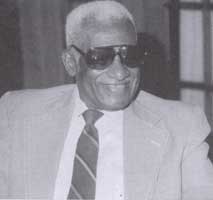
 The late Eli Copeland was an outstanding fast pitch softball player on teams such as M&S Orange and the Joe Louis Punchers but more impressive than his abilities on the diamond say those who knew him, was his demeanor off it. Copeland, being inducted tonight into the Greater Flint Area Sports Hall Fame was a beloved teammate. “Eli was one of the nicest guys I’ve ever met,” said Collins Pack of Detroit, one of the last living members of the famed Joe Louis Punchers.
“He was a great teammate. He was always upbeat. I used to go and visit with him all the time. We corresponded a lot over the years.” Being surrounded with quality people meant a lot to men like Copeland and Coffins. They were part of a combined team of All-Stars from the M&S Orange and Brown Bombers that merged into the Joe Louis Punchers, a team sponsored by the world champion boxer. They barnstormed around the country in the ’30s and ’40s playing in tournaments and exhibitions. As African American men in a time of strict segregation policies, they often encountered difficult circumstances. “We played against mostly white teams,” Pack said
“We had people call us names, but our thing was to show them that we could play. We tried to win them over with the way we played, and we did. We would play in front of huge crowds, and sometimes, when Joe Louis would travel with us, we would really get big crowds. Everyone wanted to meet the world champ. Copeland and his teammates enjoyed star-status in the African-American community.
“They were all idols to us,” explained Gerald Moore, whose father, Willie, also was an outstanding player. Gerald Moore grew up watching games at Berston Field and Atwood Stadium. We didn’t need big- league heroes to look up to. Our heroes were all here, right in front of us,” Moore said. “I’m sure a lot of them could’ve gone on and played professional baseball, but the doors weren’t open to African Americans at that time.” Although people considered Copeland a star, he never let that go to his head.
“He was always a real thoughtful person,” Moore said. “If I needed some information on a game, or a player from back in the day, all I had to do was call Eli.” Pack remembers Copeland as a steady player. Understand that we were a team of all-stars, “We had some brilliant players who could get the job done with a lot of flair.”
“Eli wasn’t that kind of player. He wasn’t real flashy but he was reliable and productive. He was a good hitter who fielded his position (right field) very well. He never struck out, and always put the ball in play.”
Copeland, who graduated from Central High School in 1937, played in adult leagues as a 15-year-old in addition to playing with the Flint Yellow Dogs and James Lumber squads. Some of his most productive seasons came with the Yellow Dogs. He led the team in hitting from 1937-39 with a combined average of .389.
Copeland played 15 seasons (1935-50). He worked at General Motors Parts Division as a supervisor for 35 years. He died in 2002 at age 83. He and wife Lena, had four children. He also had three stepsons, many grandchildren and great grandchildren. Copeland was inducted into the Michigan Amateur Softball Association Hall of Fame in 1983. In 1997, he was inducted into the Greater Flint Afro-American Hall of Fame. He would’ve been proud, and we are proud of him,” said Flint’s Charles Copeland of his father. “It’s good to know that other people take time to remember the things he did as a ballplayer. “I never got to see him play, but I’m always proud when people tell me what a great player he was.”
READ FULL BIO