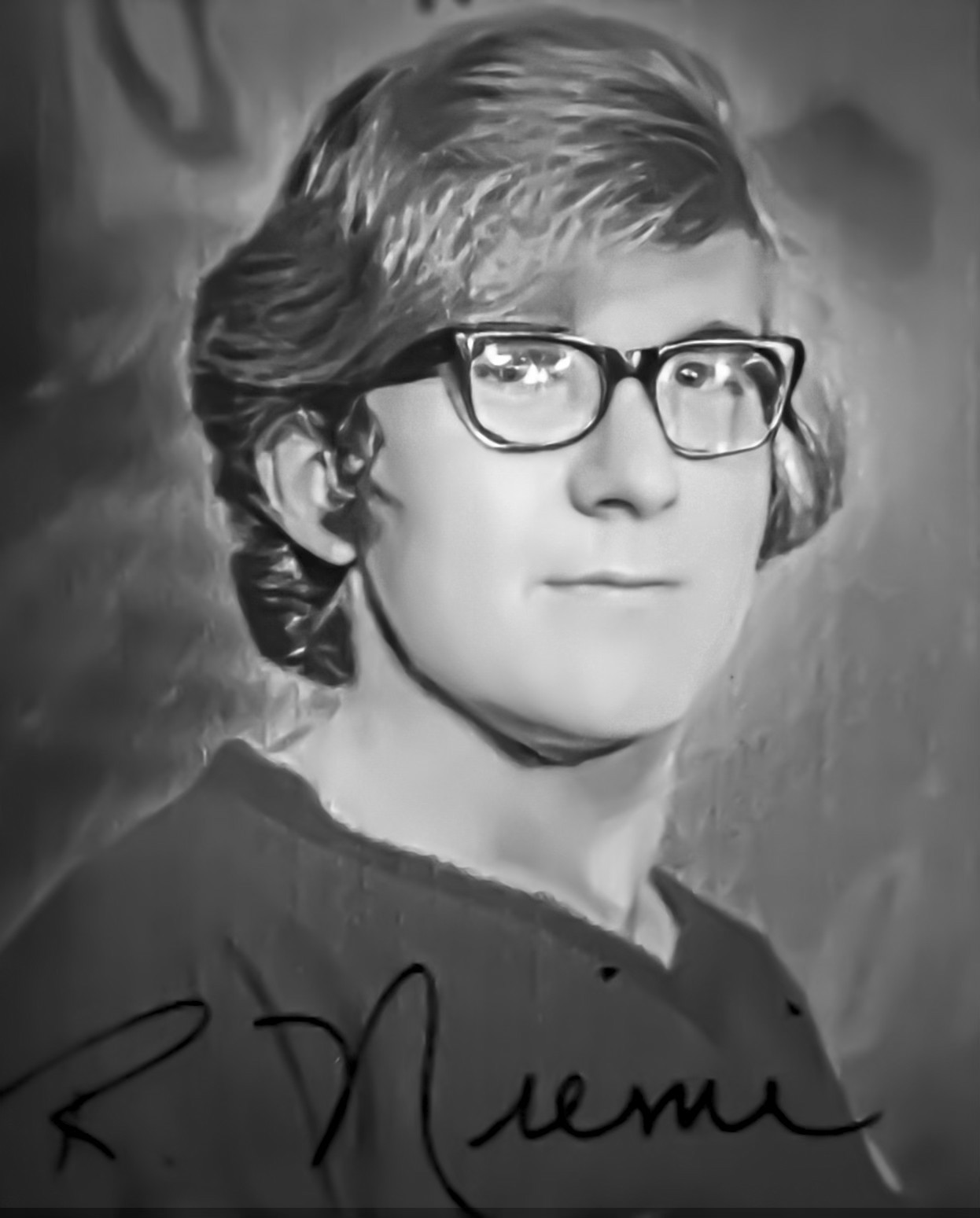
By Dan Nilsen
You might have noticed early on that Rick Niemi was a pretty good volleyball player when, at age 18, he played on the Longfellow team in both the senior boys division and the adult men’s division in the 1968 Flint Olympian Games.
Four months later, Niemi (pronounced “nee my”) again played beyond his years with the Flint YMCA team that finished fourth in a 12-team field in the annual Saginaw Holiday Tournament. His teammates included his father, Irv Niemi, and other pioneers of Flint volleyball, such as Dick Daly, Bill Mello and Frank Standard.
Those were the early days for Rick Niemi, but he was destined to go much farther than Saginaw, Michigan.
There would be domination at the collegiate level with Ball State University in Muncie, Ind.; appearances in the first three years of NCAA volleyball championships; the 1971 Pan American Trials; the 1972 U.S. Olympic Trials in Salt Lake City; global competition with the USA National Team against Japan, USSR, Poland, Canada and Mexico in the 1974 Friendship Cup in Tokyo.
Niemi’s best sport for a time was when he played tennis for Flint Central High at first singles and later with Flint Junior College, where he and a doubles partner earned a spot in the National Junior College tournament in Ocala, Fla., in June 1968. They surprised the field by reaching the quarterfinals.
But Niemi also was exposed early to volleyball by his father, who played in the city recreation leagues and brought Rick along to watch the game and then worked with him on his game.
“I watched him play and then wanted to play, and eventually, in 1968, played with him on a city rec team,” said Rick. “I wasn’t a wildcat, but men allowed me to play on a B-team level and it gave me some experience.”
Another opportunity came from Ball State University.
“Because Ball State had one of the first community director programs that Flint had started with Charles Mott and Frank Manley, that was a connection,” said Rick. “So somewhere around 1967, ’68, the Ball State volleyball coach brought teams to Flint to put on a demonstration. My father and I went to that and he got coach Don Shondell to talk to me and give me a tryout to see if I could touch the rim, which I couldn’t at that time.
“Asked what my intentions were in school, I declared elementary education as a major for me. It just so happened that Ball State ranked third in the country for most graduates in elementary education at that time. So it fit very well into playing volleyball and getting an elementary education degree.
“It wasn’t until I went to Ball State and really discovered that if you practice three hours a day for a couple of years, you get to be a whole lot better.”
Niemi was ineligible to play his first year, but he served as the stat guy and ball boy. That was 1969.
In 1970 as a sophomore, Niemi was chosen as the team’s MVP, helping Ball State to a 19-0 record and a fourth-pace finish in the inaugural NCAA championship tournament at UCLA. He was named to the Midwest Intercollegiate Volleyball Association’s second team.
In 1971 as a junior co-captain, he was a first-team MIVA selection on a Ball State team that went 17-0, 10-0 in the conference and placed third in the second annual four-team NCAA tournament. Niemi was named to the NCAA All-Tournament team and was also picked as an alternate on the NCAA All-Star team (All-American) that would participate in the Pan American Trials in Binghampton, N.Y.
In 1972, Niemi was named Most Valuable Player in the entire MIVA conference, and Ball State, which had come to be known as the volleyball capital of the Midwest, hosted the NCAA championships. The Cardinals again placed third, and Niemi again made the All-Tournament team and the NCAA All-Star team, which qualified him for the U.S. Olympic Trials in Salt Lake City. But he didn’t make the team.
Niemi accomplished all this as a 5-foot-10 setter, but he worked himself into an effective weapon at the net as well.
“He was an extremely smart setter and made very accurate passes,” said Rick Daly, a friend and fellow volleyball player. “He was also a big jumper. He could touch 11 feet, 4 inches.
“When you’re blocking, you’re playing guys that are 6-6 and can jump 36 inches, and he could still be effective.”
Niemi made that possible with a rugged training regimen.
“In the basement at Kellogg Community College, they had a level steel rack for doing squats,” he said. “You take your body weight, which was 180 pounds for me, and do 10 squats to start. Then you add 50 more pounds and then more weight until you exhaust yourself. I got to 425 one time, one squat.”
Rick’s wife, Tina, also bought him a 35-pound, sand-filled weight vest that he wore while running up and down two flights of stairs at the middle school where he taught. He did five sets of that and eventually achieved a standing jump of 40-42 inches.
“I was able to touch 11 feet, 4 inches at that time.”
He also worked on his hand speed, setting the ball where he wanted, while moving his hands so fast it looked like they never stopped.
Now out of college and teaching in the Marshall school district, along with Tina, Rick still played some volleyball and considered a professional career in it.
In 1975, he was drafted by the newly formed International Volleyball Association in California and tried out with the San Diego Breakers.
“They flew me out and an agent said we’d like to put you under contract. Now, I have two kids and my wife would stay home and give up her career in teaching.
“I told them my school has better insurance and I can’t sign a contract for $3,000. I’ve got to have at least $5,000. They cut me from the team the next day.
“One of the best decisions that ever happened in my life was not trying to figure out how to live in San Diego and play volleyball, with a family back in Marshall, Michigan.”
The decision was right, as he received the Excellence in Education Award from the Kellogg Foundation in 1993 and was the school’s Teacher of the Year in 1995. Also in 1995 he was inducted into the Ball State University Athletic Hall of Fame. The professional league lasted a few years.
Niemi continued to play recreation volleyball when he could.
“He played even when he was 40 years old,” said Rick Daly, “and he was still the premier player in tournaments that we played in.”
