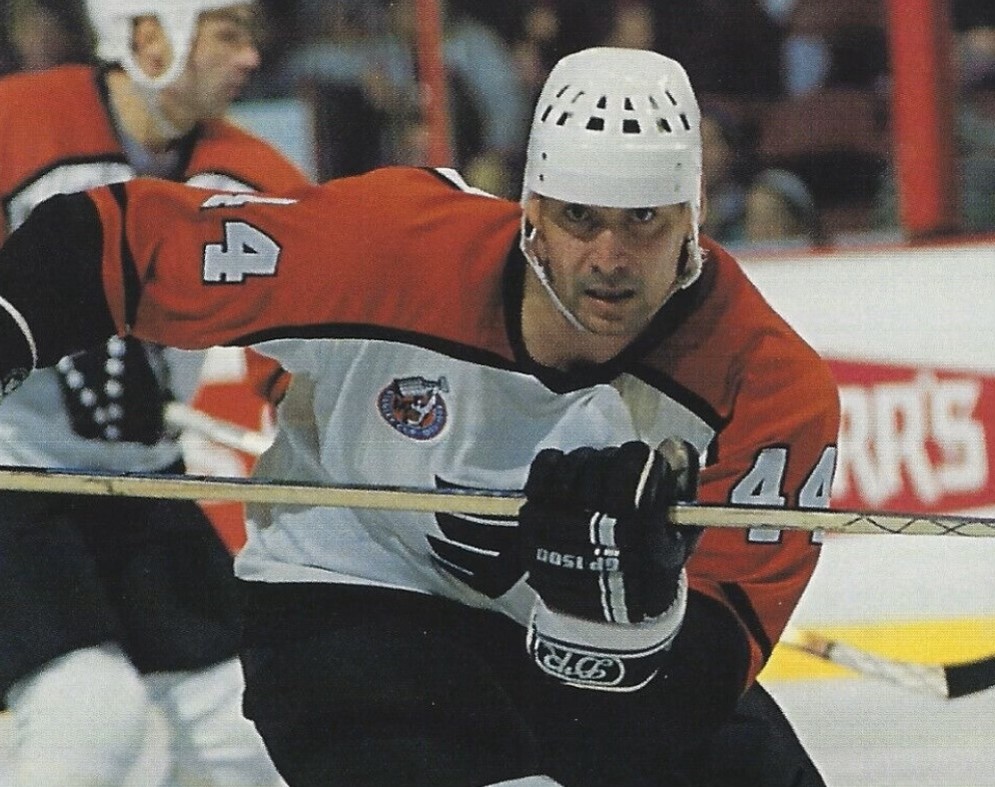
Shawn Cronin picked up a few monickers during his hockey career, all of which were based on his physical style of play.
“My nicknames growing up, one was Crusher, another one was The Wall,” he said.
But the one that stuck and will go down as one of the all-time great National Hockey League nicknames was this — Cronin the Barbarian.
He’s not sure how it was coined, narrowing down its genesis to his three-year stint with the Winnipeg Jets from 1989-90 to 1991-92.
Cronin had 703 penalty minutes and 62 fighting majors in 193 games with the Jets so … yeah, the nickname fit like a glove.
“I guess it was probably someone in the office, a play on words, Conan, Cronin,” he said.
At 6-foot-2, 225 pounds, the 1982 Flushing High School graduate didn’t back down from any of the heavyweights of the era, even engaging in two scraps with Detroit’s Bob Probert in the same game on Oct. 23, 1991.
Cronin’s physical style of play enabled him to play 292 games in the NHL with four teams. His ability to fight helped him forge an NHL career back when fisticuffs were a bigger part of the game, but he didn’t get a kick out of beating up other players.
It was just part of his innate instinct to stick up for others.
“I was always the guy that would make sure his friends were OK,” Cronin said. “If we went out to a bar or something like that and someone was picking on my friend, I would try to talk them out of it. The guy might have had a couple too many, but if he insisted on wanting to fight the guy, I would step in and say, ‘You’re not going to fight him, you’re going to fight me.’
“I was pretty much protecting my guys. I never chose or went out and started a fight, but I always tried to protect my guys. That just rolled over into hockey, too. I didn’t learn how to fight; it just sort of came naturally on the ice.”
Cronin started out in hockey later than most future NHL players. He was around 9 years old, having just moved to Michigan from Illinois, when he signed up for the Greater Flint Hockey Association.
He moved on to the Eastern Michigan Hockey Association, which played out of Four Seasons Arena on Elms Road near Swartz Creek. As he showed more promise in the sport, Cronin followed the path of many top Flint-area players and competed in the Detroit area to get better competition and exposure.
“I don’t think my parents ever thought I would get a scholarship or, God forbid, ever thought I’d be a professional hockey player,” Cronin said. “They just did it because they loved having me play and wanted me to go where I could compete and play against better players. They didn’t have a problem with it. Detroit wasn’t too far away. You’re talking an hour drive, hour and 10 minutes, hour and
15 minutes to different parts of the Detroit area.”
Cronin didn’t play hockey at Flushing, but he did play tennis as a No. 1 doubles player. Tennis, a spring sport for boys at the time, provided the least amount of conflict with his hockey schedule, which ran from September through April.
“With a lot of coaches, they say you have to be there or you can’t play,” Cronin said. “The tennis coach said when I’m finished up with hockey, I could come play with the team. I always played tennis growing up. I enjoyed tennis.”
Cronin, who was always a defensive-style defenseman, earned the interest of several Division I colleges. Michigan State offered him half a scholarship, but Cronin went to the University of Illinois-Chicago after being offered a full ride.
While playing for the Flames, Cronin was a teammate of forward Ray Staszak, who would become the first college free agent to sign a million-dollar contract. With scouts flocking to UIC games to see Staszak, the undrafted Cronin hit the radar of NHL teams.
“My junior and senior year, he was a freshman and sophomore,” Cronin said. “He was getting looked at by every scout in the league. In the process of them coming out and watching him, they noticed me. That’s where the Hartford Whalers decided, ‘Let’s give this guy a contract.’”
Cronin didn’t play for Hartford, though he did spend two months with the team late in the 1986-87 season and during the playoffs. After two years in the minors with Hartford, he signed with Washington and played his first NHL game with the Capitals in 1988-89.
Briefly.
It was only one shift, because the Capitals got behind early in the game and went with their veterans against the New York Rangers.
The Philadelphia Flyers signed Cronin the following year to a lucrative contract by minor league standards, though they quickly traded him to the Winnipeg Jets. It was only a couple years later during a conversation with Mark Howe of the Flyers’ front office that Cronin learned why Philadelphia made that move.
“He said, ‘We did that because we knew Washington was going to sign you again,’” Cronin said. “’They’re a division foe and we didn’t want you playing against us.’ What a nice compliment. They thought enough of me to sign me to a contract. They didn’t need me on the team, because they had enough tough guys, but they got me out of the division.”
The move to Winnipeg turned out to be Cronin’s big break. He played three full seasons for the Jets, his longest stint with any NHL team. He finally got an opportunity to play for the Flyers in 1992-93 before going to San Jose for his final two seasons.
It was during the 1994 playoffs in San Jose that Cronin experienced the highlight of his career — and a lowlight for Detroit Red Wings fans.
The Sharks upset the heavily favored Red Wings in a seven-game series that will forever be remembered for Jamie Baker’s winning goal in Game 7 into an empty net off an errant clearing attempt by goalie Chris Osgood.
Cronin jump-started the upset by scoring the first goal of the series 12:55 into the first game against former Winnipeg teammate Bob Essensa. It was the first goal in San Jose’s playoff history and the first of three first-period goals in a 5-4 victory that signaled the Sharks would be a problem for the top team in the NHL’s regular season.
“For a guy with only three goals in his NHL career, that was kind of exciting,” Cronin said. “I got the first goal of the playoffs in Detroit in front of everybody. It wasn’t spectacular. It was just a shot from the point that went off someone’s skate.”
Cronin played 29 games for the Sharks the following season, his last in the NHL. After two seasons as a player-assistant coach with the Fort Wayne Komets of the International Hockey League, he hung up his skates.
Now 61 years old and living in Florida, Cronin feels the impact of a hockey career that required sacrificing his body to remain in the NHL.
He recently had both knees, his right hip and his right shoulder replaced. His left hip and left shoulder will also need reconstructive surgery.
But there are no regrets.
“Those experiences were fantastic,” he said. “There are ups and downs; you run the gamut. There are friends you meet, you learn how to deal with people. I learned a lot. I had a lot of fun. I went to almost every city in the United States, ate at some of the best restaurants in the U.S. There are also negatives, but would I trade it? Probably not.”
